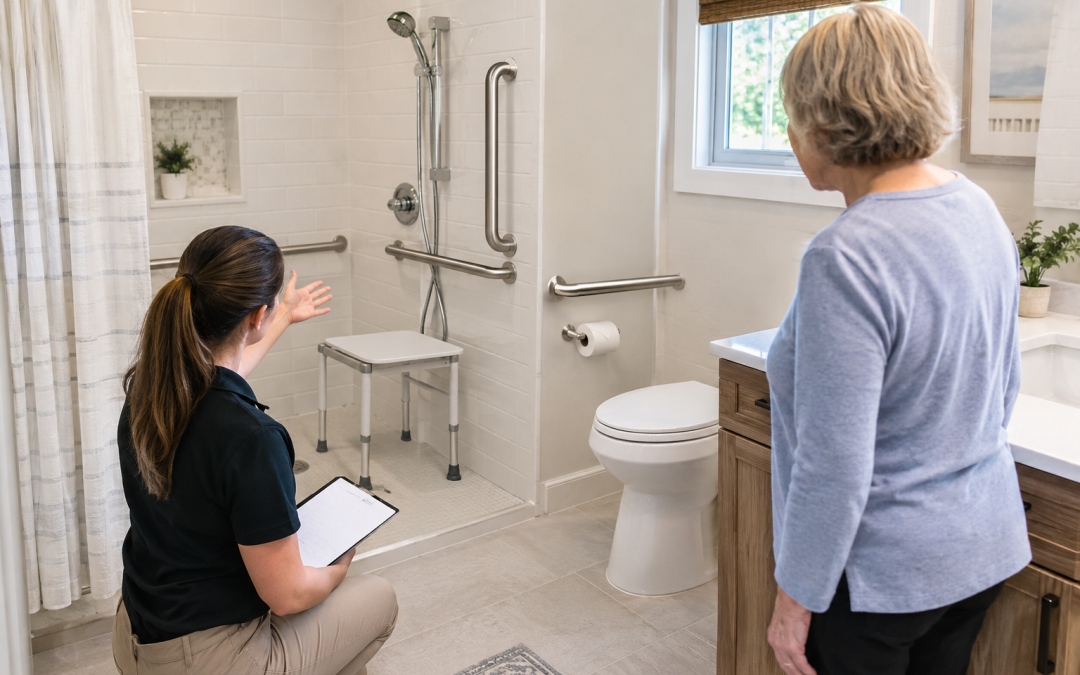

This post is part of our Vital 8 Healthy Aging Series — a blog series exploring the key areas of health that shape how well we age, and what we can do about them today.
Vital 8 Healthy Aging Series — Part 3
The Core of Everything: Why No One Is Talking About the Body System That Affects Your Balance, Your Bladder, Your Mood, and Your Independence
By Kara Welke, OTD, OTR/L, CLT & Jada Welke, OTD
There is one part of your body that affects your balance, your bladder, your confidence, your mood, your sleep, and your independence. It is connected to your risk of falling. It is connected to your risk of depression. It is connected to how well you can exercise, travel, socialize, and live the life you want.
Almost no one is screening it.
We are talking about the pelvic floor.
This Is Not Just a Women’s Issue. It Is Not Normal. And It Is Treatable.
When we talk to people about pelvic floor health, the most common response — from men and women alike — is surprise. Many men do not know they have a pelvic floor. Many women do not know theirs can be treated. That is not a personal failing. It is a systemic one.
Pelvic floor dysfunction is not a normal part of aging. It is not something you just live with.
Nearly 1 in 4 U.S. women has at least one pelvic floor disorder, and that number rises to nearly 50% by age 80. Prevalence in adult women overall reaches up to 46%, and annual direct costs for urinary incontinence alone exceed $12 billion in the United States.
Men are significantly affected too. Research shows that 74% of men referred to pelvic care centers report voiding dysfunction, 30% urinary incontinence, and 17% sexual problems. In children, pelvic floor dysfunction can present as bedwetting, constipation, urinary urgency, and toileting difficulties — conditions often undertreated or blamed on behavior when there is a physical component.
Despite these numbers, most people never mention it to their doctor. Most doctors never ask.
Why Is the Pelvic Floor So Important?
When people hear “core strength,” they think of sit-ups. But the true core is a cylinder: the diaphragm on top, the abdominal muscles in front, the spinal muscles in back, and the pelvic floor at the base.
The pelvic floor is the foundation. It co-contracts with your abdominals during every postural task — standing, walking, lifting, reaching, bending. When it is not functioning well, the entire system is compromised.
This is not just about bladder control. This is about the structural foundation of how your body moves, stabilizes, and stays upright. Research shows that core instability training improved trunk strength by 21–53%, dynamic balance by 20%, and functional mobility by 4% in older adults. When the pelvic floor is part of that system, everything works better. When it is dysfunctional, everything is affected.
Can Pelvic Floor Problems Cause Falls, Depression, and Cognitive Decline?
Pelvic floor dysfunction does not exist in isolation. The ripple effects touch nearly every domain of health.
Falls. Urinary urgency — the sudden, overwhelming need to get to a bathroom — is a recognized fall risk factor. People rush, trip, and fall. Pelvic floor muscle training combined with dual-task exercises reduced fall risk by approximately 21% in older women. Greater pelvic floor dysfunction is also directly associated with reduced gait speed — one of the strongest predictors of overall health in aging.
Depression and anxiety. A 2024 meta-analysis found depression prevalence of 25–35% and anxiety prevalence of nearly 47% in women with pelvic floor disorders. A 2025 longitudinal study found that worsening symptoms over roughly 7 years increased depression risk by 53% in midlife women. And here is the flip side: successful treatment significantly reduced anxiety, depression, and insomnia.
Cognition. Research found that 21% of women seeking pelvic floor treatment screened positive for cognitive impairment. A separate study found 15% had mild cognitive impairment and 17% had early dementia among women presenting for pelvic floor care. The brain and body are deeply intertwined.
Sleep. Nighttime bathroom trips are one of the most common sleep disruptors in midlife and beyond. Poor sleep impairs memory, increases fall risk, worsens mood, and accelerates cognitive decline. Pelvic floor dysfunction is often the hidden driver.
Activity avoidance. Perhaps the most damaging consequence is what people stop doing. They stop exercising because of leakage. They stop traveling because they cannot predict bathroom access. They stop socializing because they are anxious about accidents. The decline accelerates — and a traditional health assessment would never identify the reason.
If you read our first blog post, you may remember the question: Have you maintained your abilities, or have you slowly changed your life around what your body can tolerate? Pelvic floor dysfunction is one of the most common — and most hidden — reasons people shrink their world.
The Hidden Cost You Are Already Paying
Think about the financial side for a moment. Americans spend an estimated $750 million to over $1 billion per year on incontinence pads, adult briefs, and absorbent products. Individual spending can reach $900 or more per year — and that adds up to thousands of dollars over a lifetime.
These products manage symptoms. They do not treat the cause. For many people, the underlying dysfunction is treatable — often in a matter of weeks to months with professional pelvic floor therapy.
Now multiply that across a household. A woman spending $75 a month on pads. Her mother spending the same. Neither has ever been told that treatment exists and that it works. That is over $1,800 a year between them — on a problem that, in many cases, could be resolved.
The pads and briefs industry is massive. And it depends on people never learning that their condition is treatable. Proper pelvic floor assessment and treatment could save individuals thousands of dollars — and dramatically improve quality of life at the same time.
Do Pelvic Floor Gadgets and Devices Actually Work?
Search “pelvic floor” online and you will find hundreds of products: special chairs, vibrating devices, electrical stimulation gadgets, weighted trainers, and apps that promise to fix everything. Social media is full of influencers promoting the latest tool.
Here is the problem: most people buy these products without ever knowing what their actual problem is.
As we just discussed, some pelvic floors are too weak. Some are too tight. Some have coordination problems. The wrong device used for the wrong problem can actually make things worse — strengthening muscles that are already overactive, or adding stimulation to tissue that needs to relax.
It is like buying a knee brace without knowing whether you tore a ligament, strained a muscle, or have arthritis. The brace might feel like it is helping, but it is not fixing the actual problem.
The right approach: get assessed first. A proper pelvic floor evaluation identifies what is actually happening — then treatment targets the root cause with evidence-based methods. Spending $300 on a device you saw on Instagram is not the same as working with a specialist who can identify your specific dysfunction and build a plan that actually resolves it.
Other Countries Already Know This
In France, pelvic floor rehabilitation is a standard part of postpartum care. In 2022 alone, nearly 639,000 women received pelvic floor rehabilitation through the French national health system — generating 4.8 million clinical sessions.
In the United States, the picture is starkly different. A 2026 study documented the gap: U.S. insurers restrict pelvic floor therapy coverage to treatment of dysfunction rather than prevention. The clinical evidence supports preventive pelvic floor therapy, but insurance policy has not caught up.
The result? Millions of Americans develop pelvic floor disorders that could have been prevented — or caught far earlier — with routine screening.
When Should Pelvic Floor Screening Start?
Childbirth is the single biggest modifiable risk factor for pelvic floor dysfunction. Yet most women in the U.S. receive no pelvic floor assessment before, during, or after pregnancy. The perinatal and perimenopausal periods are critical windows of opportunity — but those windows are routinely missed.
For men, prostate surgery, chronic constipation, heavy lifting, and age-related muscle loss all contribute — and most men never learn this until a problem is already advanced.
For children, early identification can prevent years of unnecessary struggles with toileting, constipation, and the social and emotional impacts that come with them.
This is why pelvic floor screening is part of the Vital 8 — not as an afterthought, but as a core domain across the lifespan.
Does Pelvic Floor Therapy Actually Work?
It has some of the strongest evidence of any conservative treatment in rehabilitation.
Pelvic floor muscle training (PFMT) is the first-line treatment. A Cochrane review found a 76% cure rate for stress urinary incontinence with PFMT, compared to just 9% with no treatment. Pelvic floor therapy also reduced incontinence during pregnancy by 62% and by 29% in the 3–6 months after delivery.
Evidence supports PFMT for urinary incontinence, pelvic organ prolapse symptoms, fecal incontinence, postpartum recovery, pelvic pain, and sexual dysfunction. Structured programs with professional guidance consistently outperform self-directed exercises — and devices — alone.
Not All Pelvic Floor Therapy Is the Same
Pelvic floor therapy is a specialty that requires advanced training, mentorship, and years of clinical experience. Like any specialty, competence is built over time through focused practice across a range of complex presentations.
When choosing a pelvic floor therapist, ask: How long have they been treating pelvic floor conditions? What populations do they work with? What advanced training have they completed?
At Home Therapy Solutions, our pelvic floor team brings years of specialized experience across the lifespan:
– Tricia Reimann specializes in pelvic floor therapy for women across all ages — from postpartum recovery to perimenopause to older adulthood. Her depth of experience means she has seen the full spectrum of how pelvic floor health evolves across a woman’s life.
– Madysen Rehobsky specializes in pelvic floor therapy for women, men, and pediatric patients. Her training across all three populations means she understands the unique presentations, anatomy, and treatment approaches required for each — including the children and men who are so often overlooked.
Why This Is Part of the Vital 8
The Vital 8 exists because health does not happen in silos. You cannot fully understand someone’s fall risk without understanding their pelvic floor. You cannot fully understand their depression without understanding their bladder symptoms. You cannot understand their sleep disruption without asking about nighttime urgency.
The pelvic floor is the structural foundation of the body and a key driver of independence, confidence, and quality of life at every age. Most healthcare systems miss it entirely. We do not.
What You Can Do Right Now
Stop assuming it is normal. Leakage, urgency, pelvic pressure, pain with activity, and nighttime bathroom trips are common — but they are not inevitable.
Stop doing kegels without knowing if they are right for you. Generic advice can make things worse. Get assessed first.
Skip the gadgets. Know what is actually happening before spending money on products that may not address your real problem.
Add up what you are spending on pads and briefs. That money could go toward treatment that actually resolves the problem — not products that manage it forever.
Talk about it. The stigma is the biggest barrier. If your healthcare provider has not asked, bring it up yourself.
Get screened. The Vital 8 Assessment includes pelvic floor screening as part of a comprehensive evaluation across all eight domains — because everything is connected.
The Vital 8 Assessment can be completed in your home or in our clinic. If you have no current health concerns and want a proactive baseline, it is available as a private-pay wellness assessment. If you are already experiencing symptoms, an occupational therapy evaluation may be covered by insurance with a physician’s order and documented medical necessity. Not sure which path is right for you? Contact us and we will help you figure it out.
📞 Schedule your Vital 8 Assessment
📖 Learn more about the Vital 8 Framework
🔗 Read Part 1:
How Strong Is Your Body Battery?
🔗 Read Part 2:
Your Brain Is Changing. Would You Know?
Next in the Vital 8 Healthy Aging Series: The health risk hiding in plain sight — loneliness, mood, and why social connection is a vital sign.
About the Authors
Kara Welke, OTD, OTR/L, CLT, is the founder and CEO of Home Therapy Solutions and creator of the Vital 8 Framework. She developed the framework to bring comprehensive, evidence-based healthy aging assessment and intervention to adults in midlife and beyond. Kara is actively involved in research and has presented on healthy aging locally, nationally, and internationally, including at the International Association of Gerontology and Geriatrics (IAGG). Home Therapy Solutions is the only therapy practice in the area recognized as an Age-Friendly Health System practice.

Jada Welke, OTD, co-developed the Vital 8 Framework during her doctoral capstone at the University of North Dakota, completed in collaboration with Home Therapy Solutions and UND’s Department of Geriatrics and their Dakota Geriatrics program. Her foundational work on the Vital 8 was accepted for presentation at both the Gerontological Society of America (GSA) and the American Geriatrics Society (AGS).