
This post is part of our Vital 8 Healthy Aging Series — a blog series exploring the key areas of health that shape how well we age, and what we can do about them today.
Vital 8 Healthy Aging Series — Part 6
Author: Kara Welke, OTD, OTR/L, CLT and Jada Welke, OTD, OTR/L
Read the full series:
Part 1: How Strong Is Your Body Battery?
Part 2: The Missing Checkup Your Brain Needs Now
Part 3: The Core of Everything: Why Pelvic Floor Health Matters
Part 4: Beyond Standing on One Foot: What Real Balance Training Looks Like
Part 5: The One-Third of Your Life That Controls the Other Two-Thirds
Most people can name their blood pressure, cholesterol, and resting heart rate.
But almost no one knows their loneliness score. And that might be the most dangerous number nobody is checking.
In 2023, U.S. Surgeon General Dr. Vivek Murthy declared loneliness a public health epidemic — with mortality effects equivalent to smoking 15 cigarettes per day, and even greater than those associated with obesity and physical inactivity.
When was the last time any healthcare provider screened you for it?
Key Takeaways:
– Loneliness increases dementia risk by 50%, premature death by 29%, and stroke by 32%
– One in two American adults experiences measurable loneliness — most are never screened
– Modern conveniences (online shopping, delivery, remote work) are quietly removing the daily activities that kept us connected, moving, and cognitively engaged
– Loneliness screening is a core component of the Vital 8 Healthy Aging Assessment — because social connection affects every other domain of health
Loneliness Is Not What Most People Think
Loneliness is not the same as being alone. You can be surrounded by family and be profoundly lonely. You can show up at the senior center three times a week and still score high on a validated loneliness scale.
Loneliness is the gap between the social connection you have and the social connection you need. It is not about the number of people around you — it is about quality, depth, and meaning.
That is why this requires actual assessment — not assumptions. Being in a room full of people does not mean you are not lonely. Loneliness screening uses validated tools to objectively measure perceived social connection and identify individuals at risk — often before they recognize it themselves.
The Convenience Trap
Think about how daily life has changed in just the last five years:
– Groceries delivered to your door — no more walking the aisles or chatting with the cashier
– Amazon replaced trips to local stores where you used to run into neighbors
– Meals arrive with a tap — no restaurant, no shared table
– Work happens from a spare bedroom — no commute, no breakroom conversations
Every convenience removed a reason to leave the house. And every time you stay home, multiple things happen simultaneously:
→ Your balance never gets challenged — no uneven sidewalks, crowded stores, or parking lots to navigate
→ Your muscles do less work — no carrying, walking, standing, or reaching
→ Your brain gets less stimulation — no decisions, conversations, or unexpected situations to adapt to
→ Your social world shrinks — one fewer opportunity for human connection
The conveniences are not the problem. The problem is that nothing replaced what they took away. COVID accelerated all of it — and many people never fully reconnected. The change was gradual enough that most did not recognize it was happening.
In our first blog post, we asked whether you had slowly changed your life around what your body could tolerate. The same thing happens socially. People do not announce, “I am becoming isolated.” They simply do less, see fewer people, and accept a smaller life as normal.
📞 Most people do not know their loneliness score. The Vital 8 Assessment takes the guesswork out of it — evaluating social connection alongside 7 other domains that shape how well you age. Call us at (218) 230-2171 or you may book online to learn more.
Your World Gets Smaller — And No One Notices
At a recent international conference (IAGG), our founder presented on how people’s life spaces — the environments they move through regularly — shrink as they age:
– At 55: driving across town, traveling, volunteering, shopping independently
– At 70: home, one grocery store, occasional family visits
– At 80: home and yard. Or just home.
This happens one lost activity at a time. This is what it means to age in the wrong place. It is not just about whether your house is safe — it is about whether your community, access, and social world support the life you want to live.
The Danger of Decisions Without the Full Picture
Major life decisions are being made for aging adults every day without comprehensive assessment.
Someone struggles. A well-meaning professional recommends assisted living. Or takes away driving privileges. But without multi-domain assessment:
– Was the issue cognitive decline — or a medication side effect that could be adjusted?
– Was the struggle caused by physical decline — or untreated depression?
– Would environmental modifications have preserved independence?
– Did anyone assess sleep, nutrition, strength, balance, mood, AND cognition before making a recommendation that fundamentally changed someone’s life?
Taking away a person’s car keys removes their independence, community access, social connections, and sense of identity — all at once. These decisions can absolutely be the right ones. But they should be informed by comprehensive assessment — not a single observation.
That is exactly why the Vital 8 exists. Before any major recommendation, the full picture must be understood.
The Cascade No One Talks About
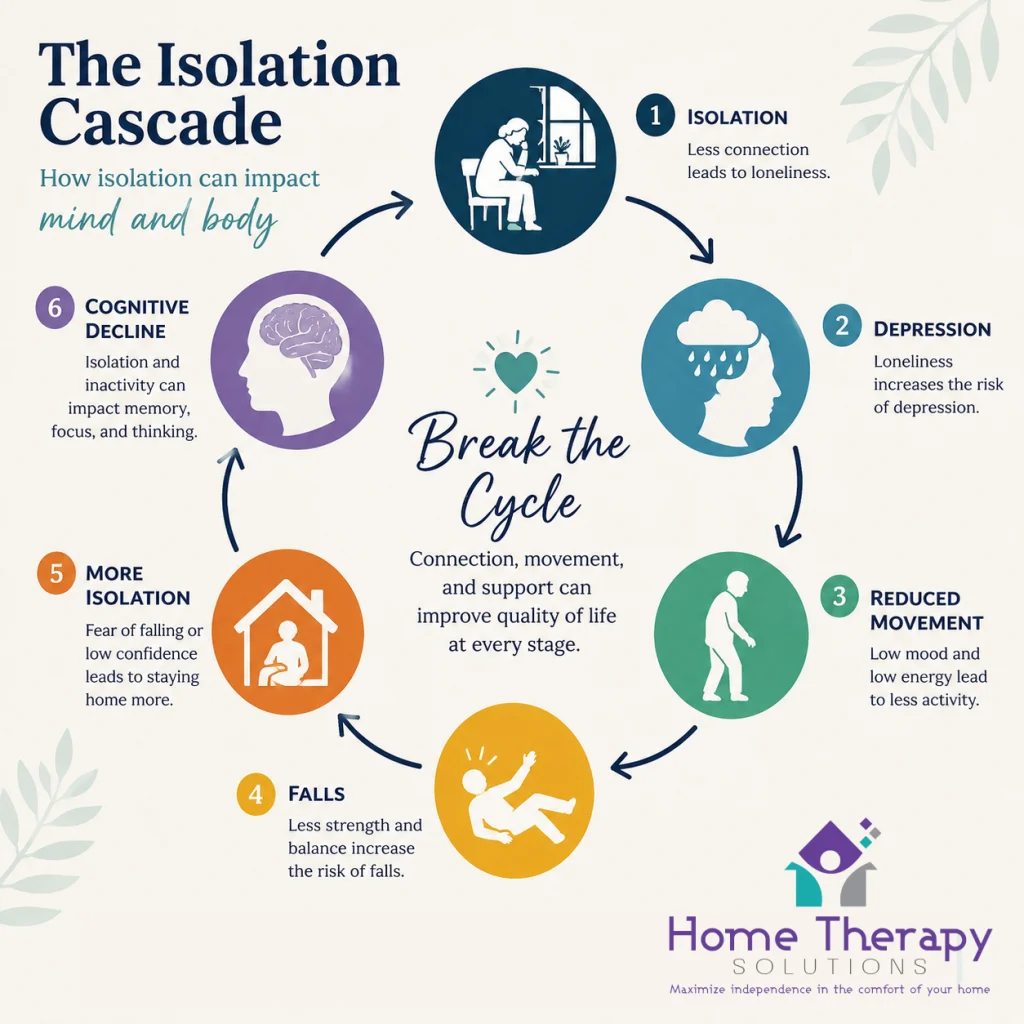
→ Isolation leads to depression → Depression reduces motivation to move → Reduced movement leads to strength and balance loss → Balance loss leads to falls → Falls lead to fear and further isolation → Isolation accelerates cognitive decline → Cognitive decline makes it harder to maintain connections → The cycle repeats — faster each time
Every step makes the next step worse. By the time most systems intervene, the cascade is well underway. Suicide rates among adults over 65 are among the highest of any age group.
Starting assessment in midlife — not at 65, not after a fall — is how we interrupt this cycle before it starts.
Everything Is Connected
If you have followed this series, you know the central theme: no health domain exists in isolation. Loneliness may be the most powerful example:
– Cognition: Social isolation is one of the strongest modifiable risk factors for dementia
– Sleep: Lonely individuals get less of the deep, restorative sleep the brain needs to clear Alzheimer’s-related proteins
– Strength and balance: Isolated people move less, lose muscle faster, and fall more often
– Depression: Bidirectional — loneliness causes depression, depression causes withdrawal
– Nutrition: People who eat alone eat worse, skip meals, and lose motivation to cook
– Pelvic floor: Incontinence causes embarrassment that drives people to avoid social situations
You cannot fix loneliness without understanding what is driving it. And you cannot fix any of these other problems without understanding how loneliness is making them worse.
Relationships and Experiences
Here is what gets lost in modern healthcare: what matters most to people is not their lab values. It is their relationships and their experiences.
It is a philosophy we believe in deeply — one shared by a local Grand Forks psychologist close to our practice: life comes down to relationships and experiences.
The ability to share a meal with someone you love. To travel somewhere new. To play with grandchildren. To feel needed, heard, and connected.
The Age-Friendly Health Systems Framework starts every care conversation with: What matters most to you? When we ask that in the Vital 8 intake, people never answer with a medication name. They talk about people. They talk about places. They talk about the things they want to keep doing.
Protecting those relationships and experiences is the entire point of proactive assessment.
“But I Am Not Lonely”
Many people reading this are thinking exactly that. But consider:
– Have you slowly reduced how often you see friends?
– Do most days pass without meaningful conversation beyond your household?
– Has online shopping replaced every errand that used to get you into the community?
– Do you find yourself scrolling a screen instead of connecting with people?
– Have you noticed your world getting smaller — fewer places, fewer people, fewer experiences?
Loneliness does not always feel like loneliness. Sometimes it feels like tiredness. Sometimes it feels like “just being a homebody.” Sometimes it feels like nothing at all — until a screening reveals a score that surprises you.
What Can Actually Be Done?
The good news: social connection is modifiable. But “just get out more” is not a treatment plan.
The solution to loneliness might not start with social connection at all. It might start with treating depression, improving balance, addressing pelvic floor symptoms, or modifying an environment. That is why we assess all eight domains together. A recommendation made without the full picture can be the wrong recommendation — even with the best intentions.
At Home Therapy Solutions, we offer programs specifically designed to address these interconnected challenges — including Cognitive Stimulation Therapy, evidence-based intervention programs, and individualized plans that target the actual barriers to engagement and participation.
If you are a healthcare provider looking to ensure your patients receive comprehensive, multi-domain healthy aging assessment before major recommendations are made, we welcome referrals and collaboration. Contact us to learn more about the Vital 8 Framework.
📞 The Vital 8 Healthy Aging Assessment evaluates social connection alongside physical health, cognition, balance, sleep, nutrition, pelvic floor health, medication safety, and home environment. Home Therapy Solutions is the only recognized Age-Friendly therapy practice in Grand Forks. Call us at (218) 230-2171 or you may book online to schedule your assessment.
FAQ: Social Isolation, Loneliness, and Healthy Aging
According to the U.S. Surgeon General’s 2023 advisory, the mortality impact of social disconnection is similar to smoking up to 15 cigarettes per day. Loneliness increases the risk of premature death by 26–29%, dementia by 50%, and stroke by 32%.
Yes. You can attend the senior center regularly, have family nearby, and still score high on a validated loneliness scale. Loneliness measures perceived connection — not activity level. That is why screening matters.
Every errand replaced by online ordering removes physical activity, cognitive stimulation, balance challenges, and human contact. COVID accelerated this shift, and many people never reconnected. The change is gradual enough that most do not recognize it.
Decisions like moving to assisted living or giving up driving restructure every aspect of a person’s life. They should be informed by comprehensive assessment across cognition, mood, physical function, medications, environment, and social connection — not a single observation.
Yes. Aging trajectories are shaped by factors present in midlife. The pandemic accelerated isolation across all age groups. The Vital 8 is designed for adults beginning at age 50.
About the Authors
Kara Welke, OTD, OTR/L, CLT is the founder and CEO of Home Therapy Solutions and creator of the Vital 8 Framework — a comprehensive, evidence-based healthy aging assessment and intervention program for adults in midlife and beyond. She is actively involved in research and has presented at national and international conferences including (IAGG). Home Therapy Solutions is the only recognized Age-Friendly therapy practice in Grand Forks, ND.

Jada Welke, OTD, OTR/L co-developed the Vital 8 Framework during her doctoral capstone at the University of North Dakota, completed in collaboration with Home Therapy Solutions and the UND Department of Geriatrics and Dakota Geriatrics program. Her work on the Vital 8 was accepted for presentation at both the Gerontological Society of America (GSA)